
Rev. Jared Buss
Pittsburgh New Church; October 6, 2024
Readings: Judges 7:1-8 (children’s talk); Judges 6:25-27, 36-40; Secrets of Heaven §8478.2, 3
We’re going to begin this portion of the service by reading more of the story of Gideon, from the book of Judges. We’re going back in time, a little bit: these readings are about things that happened before Gideon winnowed his army down to just three hundred men. And all of these readings point to Gideon’s struggle with confidence. When the Angel of the Lord told Gideon that he was called to deliver Israel, Gideon answered, “O my Lord, how can I save Israel? Indeed my clan is the weakest in Manasseh, and I am the least in my father’s house” (Judges 6:15). Clearly he felt that he was inadequate. Here’s what we’re told about the first assignment that the Lord gave to Gideon: [read vv. 25-27]. And a little further on, we read: [vv. 36-40].
So Gideon did what the Lord told him to do: he tore down the altar of Baal. But he did it at night, because he was afraid. Then, when he was getting ready to go out to battle with the Midianites, he asked the Lord for a sign. He needed reassurance that the Lord was really there. Fair enough. So he laid out a fleece, and asked the Lord to make the ground dry but the fleece wet. The Lord did what he asked—and Gideon still wasn’t confident! He needed another sign. He needed the Lord to make the ground wet, and the fleece dry. It’s pretty clear that he was struggling to feel ready to do what the Lord was calling him to do.
A lack of confidence is a pretty familiar thing. Who here can’t remember a time when they had to do something that they just didn’t feel ready to do, or didn’t think they were good enough to do? A presentation or a performance of some kind, just as an example. In situations like those, doubt and anxiety can feel like massive weights holding us down. Self-doubt and anxiety can also run through people’s lives below the surface—sometimes just below the surface. Sometimes they climb up and overwhelm us, maybe because we’re dealing with something hard, maybe for no reason that we can identify.
When we struggle with a lack of confidence, we want reassurance. Of course the Lord is willing to reassure us. That’s very much a thing that He does. That’s what we just see in the story of Gideon and the fleece: Gideon asks for signs, and the Lord patiently gives them to him. And this isn’t the first story in which Gideon asks for a sign, by the way—he asked the Lord for a sign the very first time that the Lord ever appeared to him (Judges 6:17).
But in the story that we heard during the children’s talk, the Lord takes Gideon’s army and He makes it smaller. He winnows it down to almost nothing. That would be an unusual way to prepare for battle under any circumstances, but it’s especially strange when you consider that the Lord knew He was working with an insecure commander. How was shrinking Gideon’s army from thirty-two thousand to three hundred going to help him feel confident? You’d think that this sort of thing would happen when the Lord was working with someone who was shockingly arrogant. “You think you’ve got it in the bag, because of your grand army? Let me show you what I can do without your army.” You’d think that if anyone needed to feel thirty-two thousand allies at their back, it would be someone like Gideon.
But the Lord knows what He’s doing. So what does He do when we lack confidence? What does He tell us? What does He ask us to do?
As I said, the Lord does reassure His people. Sometimes we just need comfort; and sometimes when we go to the Word, or turn to the Lord in prayer, comfort is exactly what we find. But sometimes the Lord takes our army and makes it smaller. Gideon’s army, thirty-two thousand strong, must symbolize things we think we need that we actually don’t need. In the internal sense of the Word, armies symbolize truths—because the truth that we have from the Lord is what goes out to battle against falsity and evil (SH §§3448, 7236). A big army, therefore, would symbolize a whole host of truths—an expansive knowledge of the truth. That seems like a good thing. How could an expansive knowledge of the truth be bad? But maybe the problem that this story identifies isn’t “having a big army”—maybe the problem is “needing a big army.” Maybe the problem is the feeling that we need to understand more than we’re capable of understanding, and the belief that if we make it through the things we’re dealing with, it will be because we figured it out. We found the right tool. So we hoard as many tools as we can.
This lines up with what the Lord says in the story: “The people who are with you are too many for Me to give the Midianites into their hands, lest Israel claim glory for itself against Me, saying, ‘My own hand has saved me’” (Judges 7:2). The whole point of so many of the stories of the Word is that we need the Lord. We cannot save ourselves, no matter how big an army we have at our backs. But the bigger the army we have, the more likely we are to forget we need Him.
When we’re afraid, or when we lack confidence, our instinct is often to amass as big an army as we can. We gather truths—we take inventories of our abilities and our intelligence. We hoard affirmations; we count our successes, and use those lists of successes to prop up our faltering confidence. Maybe we become the spiritual or emotional equivalents of people who build bunkers in anticipation of the end of the world. We stock our bunker with every imaginable piece of equipment, but doing so doesn’t really make us feel more secure. It only reinforces the fear that drove us to that task in the first place. And while we’re focused on all of that, we tend to forget the one thing we truly need—which is the Lord.
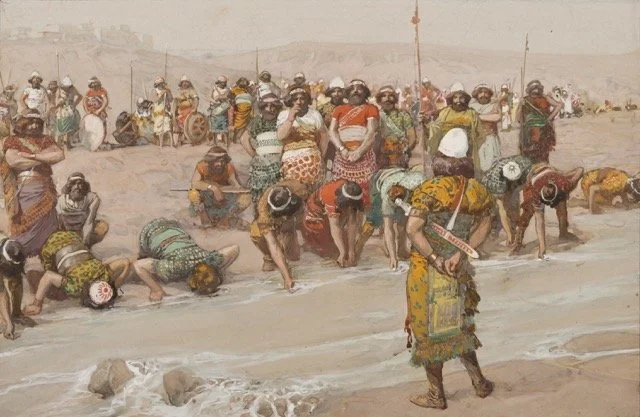
The Lord reduced Gideon’s army to just three hundred men, and He selected the men who lapped water with their tongues, as a dog laps (Judges 7:5). In the internal sense of the Word, three hundred symbolizes fullness, or a complete amount (SH §5955). And in the Heavenly Doctrine of the New Church we’re told that those who lapped water with their tongues like dogs:
… mean such as have an appetite for truths, thus they who from some natural affection seek to know truths, a “dog” signifying appetite and eagerness, “waters” [signifying] truths, and “lapping them with the tongue” [signifying] to have an appetite for and eagerly seek. (AE §455.9)
What we know isn’t really what matters; what matters is our eagerness to know, or our willingness to learn. The Lord doesn’t need us to be brilliant—He needs us to be willing to follow. If we’re willing to create a space in which He is the first and the only thing, and we ask Him to show us what we need to do, He will show us something. And that will be what we need. Maybe not what we thought we needed—but what we need.
I’m going to share a longer reading from the Heavenly Doctrine of the New Church. This passage is about people who are “concerned for the morrow,” which is the same thing as not trusting in the Lord. What I invite you to note in this reading is how it emphasizes that the people described here are people who need everything—people who need to possess or control all things. The reading is from Secrets of Heaven [read §8478.2].
We’ll pause there before we continue with the second half of the reading. This passage puts “anxiety over the future” side-by-side with “the desire to possess all things and exercise control over all other people.” Amassing an army of tools so that we will be equipped to fix every problem might seem like the way to cure our anxiety, but it actually tends to make anxiety worse. This can turn into a vicious cycle: The more we try to control everything, the more we feel like we’re failing—because we aren’t that strong—and the more we feel like we’re failing, the more out of control the world feels, so the more we try to control everything. Now I’ll continue with the second part of the reading [SH §8478.3].
Trust in the Lord changes everything. The whole point of the paragraph I just read is that when we trust in the Lord, it doesn’t matter what we have—or what we don’t have. We have the Lord, and He is the architect of every good thing. For what it’s worth, I’m not aware of a single passage anywhere in the Old Testament, the New Testament, or the Heavenly Doctrine that speaks well of self-confidence. When we lack confidence, we tend to think that self-confidence is what we need. But if “self-confidence” means that we look ourselves to create the things that will make us happy, our self-confidence will fail us. Because we can’t create those things. True confidence is confidence in the Lord, because the Lord is the one who creates love and joy and peace; and He’s strong enough to put them into our hands. And then, from the Lord, we receive a kind of self-confidence, which is confidence that we are able to do what we need to do, because The Lord is with us.
All of this is illustrated in another story from the Old Testament—the story of David and Goliath. David was a very different sort of hero from Gideon. David was a teenager who chose to go up against a giant, without being asked to, because he was confident that the Lord was with him. The whole point was that it was a one-on-one fight, so nobody thought that David should have a big army. But Saul, the king, tried give David all the best equipment. He gave David his own armor. But David refused the king’s armor—he said he couldn’t walk in it (1 Sam. 17:39). He went out to face Goliath with nothing but stones and a sling; and, famously, he told the giant: “You come to me with a sword, with a spear, and with a javelin. But I come to you in the name of the Lord of Hosts” (v. 45). And then he won the battle. All the armor—all the resources in the world—cannot save us by themselves. They cannot heal our souls; they cannot give us peace. But as for that willingness to follow the Lord, a little is enough, and enough is everything.
When the Lord is with us, we’re invincible. It doesn’t matter how little we know—how small we are in the face of the world. Being outnumbered by the demons we encounter is nothing: we have the Lord. At the end of his life, Joshua, who had been the commander of the armies of Israel, told the people: “One man of you shall chase a thousand, for the Lord your God is He who fights for you, as He promised you” (Josh. 23:10). In the Heavenly Doctrine we’re told that what Joshua says here is exactly what goes on within our spirits: “The angels, being governed by good, have so much power and control over hellish spirits that just one of them can subdue thousands of those from hell” (SH §6677). We don’t need armies: we need the Lord. We need to let His goodness govern our lives. Joshua said: “One man of you shall chase a thousand, for the Lord your God is He who fights for you, as He promised you. Therefore take careful heed to yourselves, that you love the Lord your God” (Josh 23:10, 11).
Amen.