
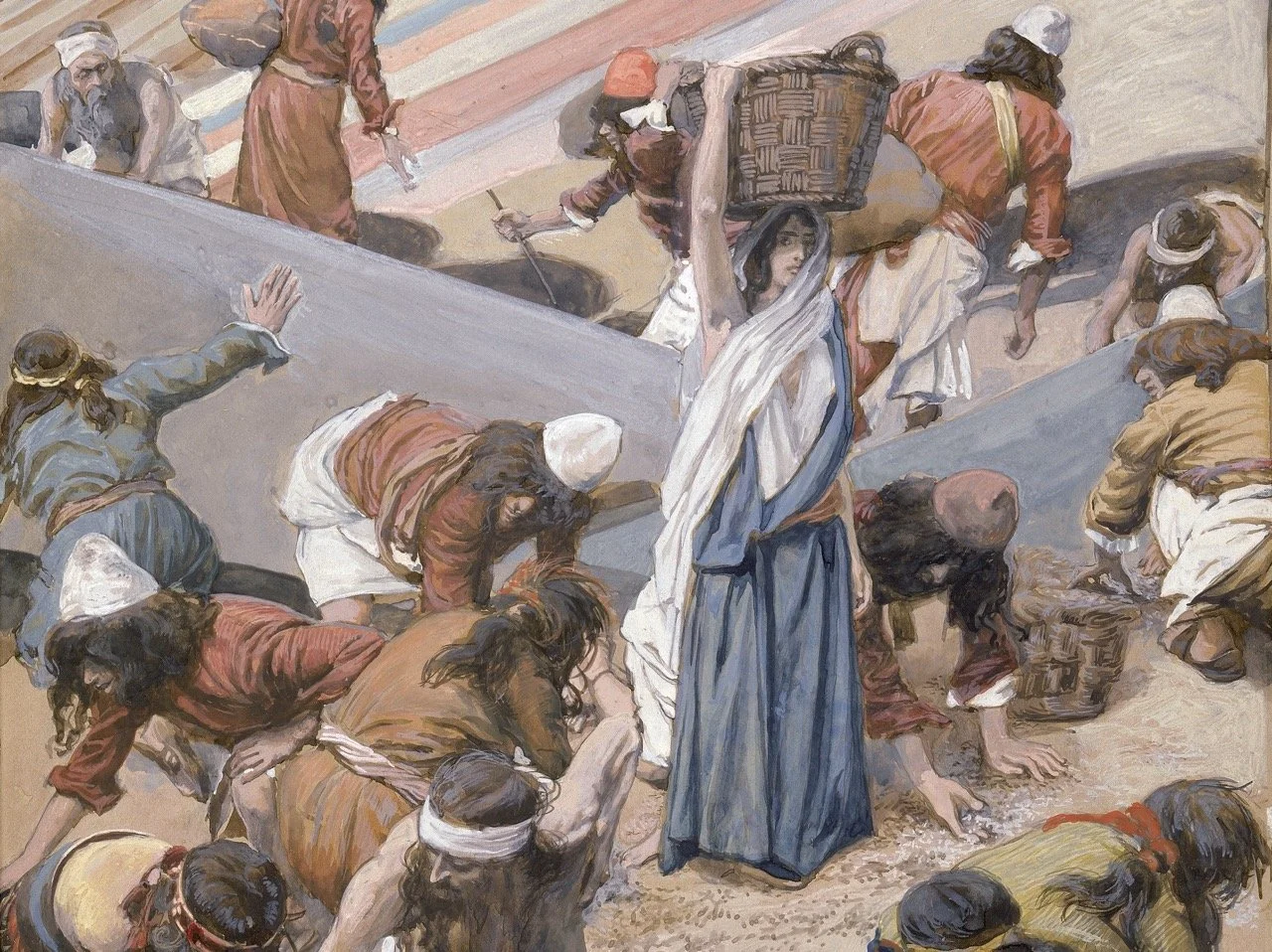
This sermon was given by Rev. Jared Buss on September 20, 2026
Text:
The story of the Lord feeding His people with manna in the wilderness is very much a story about trusting in the Lord. If He says “follow Me,” and we follow Him, we can trust that it’s going to work out, no matter what the journey looks like to our eyes. But specifically this story is about food, and trusting that the Lord will feed us—and that’s what we’re going to focus on now.
Most of us here today probably don’t struggle with anxiety about whether or not God will provide us with enough to eat. Of course there are people even today who go hungry. If that’s something you struggle with, please come talk to one of the pastors. But in general our access to food is far more reliable than it used to be. The experience of journeying through the wilderness and being genuinely concerned that we might starve is probably not one that any of us have had. But if we go up a level, and think about being provided with spiritual food, that’s a whole different story. Do we trust that the Lord will feed our spirits? That’s what we’re going to focus on today.
First of all, what is spiritual food? Spiritual food is everything that nourishes our spirits and makes us feel alive on the inside. The main thing that does this is love (see SH §8410). So spiritual food, broadly speaking, is love. This could be selfish love, or it could be heavenly love: whatever its nature, love makes us feel alive. And that really isn’t too hard to see. Love is what motivates us and gives us purpose. Love is the source of every delight, because delight is simply what happens when love gets what it wants. And if you have no sense of purpose and no awareness of any delight, then you feel empty—something inside you is desperately hungry.
And that’s the spiritual state that’s symbolized by the children of Israel’s complaints at the beginning of this story. The children of Israel represent people who are trying to let the Lord make them spiritual, people who are trying—sometimes successfully and sometimes not—to let Him lead them to the promised land. The thing about following the Lord on that journey is that in order to do it we have to give up or leave behind the old loves, the old delights—the things we used to live for. And there’s this period where we’ve given up the old life, or tried to, but haven’t really tasted the new: so we feel like what we have is a lot of nothing.
So there’s something in us that complains to God, just like the children of Israel did. They said:
Oh, that we had died by the hand of Jehovah in the land of Egypt, when we sat by the pots of meat and when we ate bread to the full! For you have brought us out into this wilderness to kill this whole assembly with hunger. (Ex. 16:3)
And now we’ll turn to the first of our readings from the Heavenly Doctrine of the New Church, which is about spiritual sense of those words. This reading is from the book Secrets of Heaven, and is printed on the back of the worship handout [§8413].
So this is a pretty straightforward teaching. The Lord’s plan is to instill the good of charity, or plant it within us; but before that can happen, the delight belonging to “lower pleasures” has to be cleared out. The old has to go so that there’s room for the new. And that’s because we can only be moved by one type of love at a time—as the Lord says, “no one can serve two masters” (Matt. 6:24). But there’s this period where we’ve left the old behind, but we haven’t yet received the new. Or more accurately, we haven’t yet learned how to enjoy the new life. So there’s this part of us that says, “What gives? God has sold me a lemon!”
There’s a stereotype that’s probably as old as organized religion that says that religious life is dull and tedious, that religious people are killjoys, and that the irreligious people are the only ones who know how to have fun. “Only the good die young,” and all that jazz. Now, if we were completely convinced by that stereotype, we probably wouldn’t be here right now. But it does feel kind of true sometimes, doesn’t it? Sometimes it seems that the people who don’t care what the Word says are the ones who get to live for thrills and adventures, and maybe we also see that those thrills are hollow thrills—“but,” we say in our hearts, “where’s my reward for doing it right?”
It is true that everyone who chooses to follow the Lord has to give something up. Even people who never did choose to live the wild life have to give something up. They have to give up the old life. As the reading put it, “the delight belonging to lower pleasures, which has constituted a natural life, is taken away” (SH §8413.2). Those lower pleasures aren’t necessarily evil things. They might be—the satisfaction of taking revenge is an example of an evil pleasure. But these lower pleasures might also just be ordinary, natural things that we enjoy, like eating food and making money and being praised and promoted. There’s nothing wrong with enjoying these things—and that’s important. We aren’t asked to renounce all worldly pleasures and take vows of poverty and chastity (see SH §8413.3). But we need to stop living for these lower pleasures. We need to stop treating them as our primary spiritual food.
Think about it: on a given day, what is it that motivates you to make it through the day? What good or good-seeming things are you living for? What loves or pleasures are you using to sustain yourself? It’s probably a mixed bag. Maybe there’s a genuinely useful project that you’re involved with at work, and some of the time you are genuinely energized by that use. And then, maybe, there are times when the thing that gets you through the day is the thought that there is ice cream in the freezer at home. It’s not like it’s so terrible to have those days where “ice cream” is our happy thought—but we don’t want to live that way, do we? We don’t want that kind of affection to be who we are. We want to make room for a spiritual affection! That’s why we’re trying to follow the Lord in the first place. So there is a pleasure in lower things—a life built around lower things—that has to be relinquished.
And when we let go of that life, there is an empty moment. There’s a period where we’re in the wilderness. We’ve left spiritual slavery behind, but we’re not in the promised land either. We’re not feeling the joy that the Lord said we would feel. Didn’t He promise us a land flowing with milk and honey? (Ex. 3:8). But we’re in the wilderness. Our spirits find themselves in a wide, lonely land. And at this point it’s easy to look back and say, “Man, I used to be happier. Maybe I was living a shallower life back then—but didn’t I use to feel more alive?” And often, in that state of spiritual hunger, we experience some kind of resentment or frustration with God. We say, “I’m not seeing what You promised me. This isn’t what I thought I’d get when I chose to do it Your way!”
In the story, the children of Israel say, “You have brought us out into this wilderness to kill this whole assembly with hunger” (Ex. 16:3). And the next line is, “Then Jehovah said to Moses, ‘Behold, I will rain bread from heaven for you.’” (v. 4). So that’s the Lord’s answer when we complain to Him. “I will rain bread from heaven.” And bread means love. So He says, “I will rain love from heaven upon you. You’re worried that you won’t have enough—I will give you more than you can hold.” There are many other passages that speak of His desire to bless us this way—to fill us to overflowing. In Luke He says, “Give and it will be given to you: good measure, pressed down, shaken together and running over will be put into your bosom” (6:38).
So that’s His promise. But at this point in the story, raining bread from heaven is simply something that Lord says He will do, not something He has done. It’s just a promise. And for us, as we’re beginning the journey of regeneration, the promise is just a promise—just an idea we believe, not a reality that we have a living awareness of. But the rest of the story is about how the Lord begins to make those joys real to us.
First the Lord gives Moses a lot of instructions about what’s going to happen and how the people are to gather the manna. For today we’re mostly going to pass over these instructions—but one simple thing that’s worth noting out loud is that the people still had to go out and gather the manna. God sent the bread down from heaven, and there could be no doubt that it was His gift—but the people still had to choose to get up and gather it. We too have a part to play. Spiritual happiness is God’s gift, but there are things that we need to do, if we want to receive it.
And still, at this point, no bread has actually come down from heaven: it’s all just been talk about what’s going to be. There’s this period where our hope and our comfort come mostly from our knowledge of the things that God has said He is going to do. And then the morning comes. We read: “…and in the morning, the dew lay all around the camp. And when the layer of dew lifted, there on the surface of the wilderness, was a small round substance, as fine as frost on the ground” (Ex. 16:13, 14). So the people find two things in the morning: the dew, and the manna beneath it. The dew is only there for a short while: it rests on the manna, it blesses the manna, and then it goes up. But it symbolizes something wonderful. We turn now to our final reading, which is also from Secrets of Heaven, and is also on the back of the handout [§8455].
So as we’re journeying onward, towards the promised land, we go through these states—and maybe they last a long time—where we just don’t feel the joy of living with the Lord. We feel like we’ve lost an old life that we used to have, and have gained little in return. And we trudge onward through the wilderness, and we wait; and then there comes a morning state, in which the Lord touches our spirits with the truth of peace. That truth is His own truth: it’s like seeing a glimpse of the Lord Himself in the light of the morning. And in His presence we have peace, peace that holds within itself trust that He governs all things and provides all things. Of course He’s going to feed us forever. There are moments where all of that shines through.
Those moments never last forever. The dew is there, first thing in the morning, and then it goes up to heaven. And what’s left behind is the manna—the bread from heaven. This bread is a gift of love and a gift of strength from God. It’s what sustains our spirits so that we can continue the journey to the promised land. But here’s an interesting detail: specifically, the manna symbolizes the “the good of charity which the truth of faith gives birth to” (SH §8462). The manna symbolizes good that comes from truth. That’s why it’s described as a “small round substance” (Ex. 16:14). Size and measurements have to do with truth, and roundness or softness have to do with good. The manna is small because it’s something that’s just beginning: it symbolizes truth that is just beginning to become goodness.
And what does that mean? It means that at some point, all of those things that we’ve been doing not because they give us joy but because we believe it’s right to do them, start to take on a different quality. They cease to be merely obligations. They stop feeling so hard and so lonely, and start to feel alive. Acts of service start to feel less like chores, and more like the reason we’re here in the first place. Keeping the Lord’s commandments starts to feel less like a burden, and more like liberation. The things that we once did just because we believed they were right become a source of joy unto themselves. The truth becomes goodness, and it feeds our souls. And if doing the right thing can feed us and fill us, we need never be hungry.
Amen.