
Rev. Jared Buss
Pittsburgh New Church; December 14, 2025
Video:
Text:
Readings: Matthew 1:18-25 (children’s talk); True Christian Religion §766; Matthew 18:15-17
Last Sunday we talked about Mary, and how her acceptance of the call to become the mother of the Lord sets an example for us all. When the Lord calls us in unexpected ways, we can strive to answer as she answered: “Let it be to me according to your word” (Luke 1:38). This Sunday we’re reflecting on Mary’s husband, Joseph, and what we can learn from him about receiving the Lord.
Of course none of us will receive the Lord the way that Mary and Joseph did—as a baby to physically care for. He has already been born on earth, and never will be again, because Divine work does not get undone. But it’s not like the Lord made His advent to a certain set of people who lived thousands of years ago and doesn’t come to us today. Right now He is striving to make a spiritual advent to each of us, as individuals. We’re told as much in True Christian Religion; you can find this reading in your handout [read §766].
When we receive the Lord, He comes to us and is present with us in a new way—something new dawns within us. And that moment of reception is the advent of the Lord. And in many ways it’s what Christmas is all about. It is so important to celebrate what happened two thousand years ago; but for us right now, the thing that makes the biggest difference is our willingness to receive Him not just as “somebody’s God” but as our God, Creator, Redeemer and Savior. When we are so willing, something new from Him is born within us.
And Mary and Joseph show us this willingness. They show us how to receive Him. They accepted that He would come and turn their lives upside down two thousand years ago; and in the internal sense of the Word, they represent the attitudes and qualities that are able to receive the Lord—the Lord who even now is with you, urging and pressing to be received.
More than anything else, the quality that receives the Lord is a humble willingness to let Him change our lives; that’s the quality that Mary demonstrates so wonderfully. In the Heavenly Doctrine we’re told what she symbolizes in the internal sense of the Word: she symbolizes “the church as to the affection of truth” (God the Savior §37). In other words she stands for a tender affection, an innocent affection for what is right and beautiful. But, as I said, we’re focusing on Joseph today, not on Mary.
The Heavenly Doctrine doesn’t spell out what Joseph symbolizes. But there’s a lot that we can work out just by looking at the story: he is Mary’s husband, her other half. She symbolizes an affection, which has to do with the will, or the heart; so he must symbolize something having to do with the understanding, or the head. The understanding is the partner to the will. If you look at the story, it’s pretty conspicuous that Mary’s job is tender—her job was to carry a baby—and that Joseph’s job is less so: he’s associated with all of the hard decisions that needed to be made to protect Mary and the baby. She stands for innocence within us, and he stands for something thoughtful.
In many ways, Mary’s job was the more important one: she was the one who actually bore the Lord into the world. But it’s also pretty clear that if Joseph hadn’t been there, and if he hadn’t done the things he did, the Christmas story would not have ended happily. If he had publicly accused Mary of adultery, she might have been put to death. Even if she wasn’t, she would have been outcast and shunned, and then the Lord wouldn’t have been born into the orderly context that He needed to be born into. We’re told in the Heavenly Doctrine that, “It was necessary for Him to be born of a virgin in legitimate marriage with Joseph” (God the Savior §38). Joseph also provided for Mary; it was difficult for women to earn money in that era and culture. Food seems like a trivial thing when we’re thinking about the Lord who saved heaven and earth—but if Mary hadn’t been able to eat, she couldn’t have had a baby. Joseph was also the one who received the warning, from an angel in a dream, that Herod would try to destroy the Lord (Matthew 2:13), and he was the one who took Mary and the baby to safety in Egypt (v. 14).
The point is that Joseph symbolizes something necessary: if we’re to receive the Lord, if He is to make His advent to us, then there needs to be something in us that plays Joseph’s part. And again, Mary represents something having to do with the will—and we need to be willing to receive the Lord—while Joseph represents something having to do with the understanding. Our understanding needs to be prepared, if we’re to receive the Lord.
So what we’re going to do now is look more closely at Joseph’s behavior, as it’s described in the reading from Matthew, and reflect on what we can learn from him about how we should prepare ourselves to receive the Lord. There are two specific things that Joseph does that we’re going to focus on: the first is that he acts thoughtfully and carefully, and with integrity. The second is that he is willing to get himself out of the way.
His commitment to acting thoughtfully is testified to in these verses:
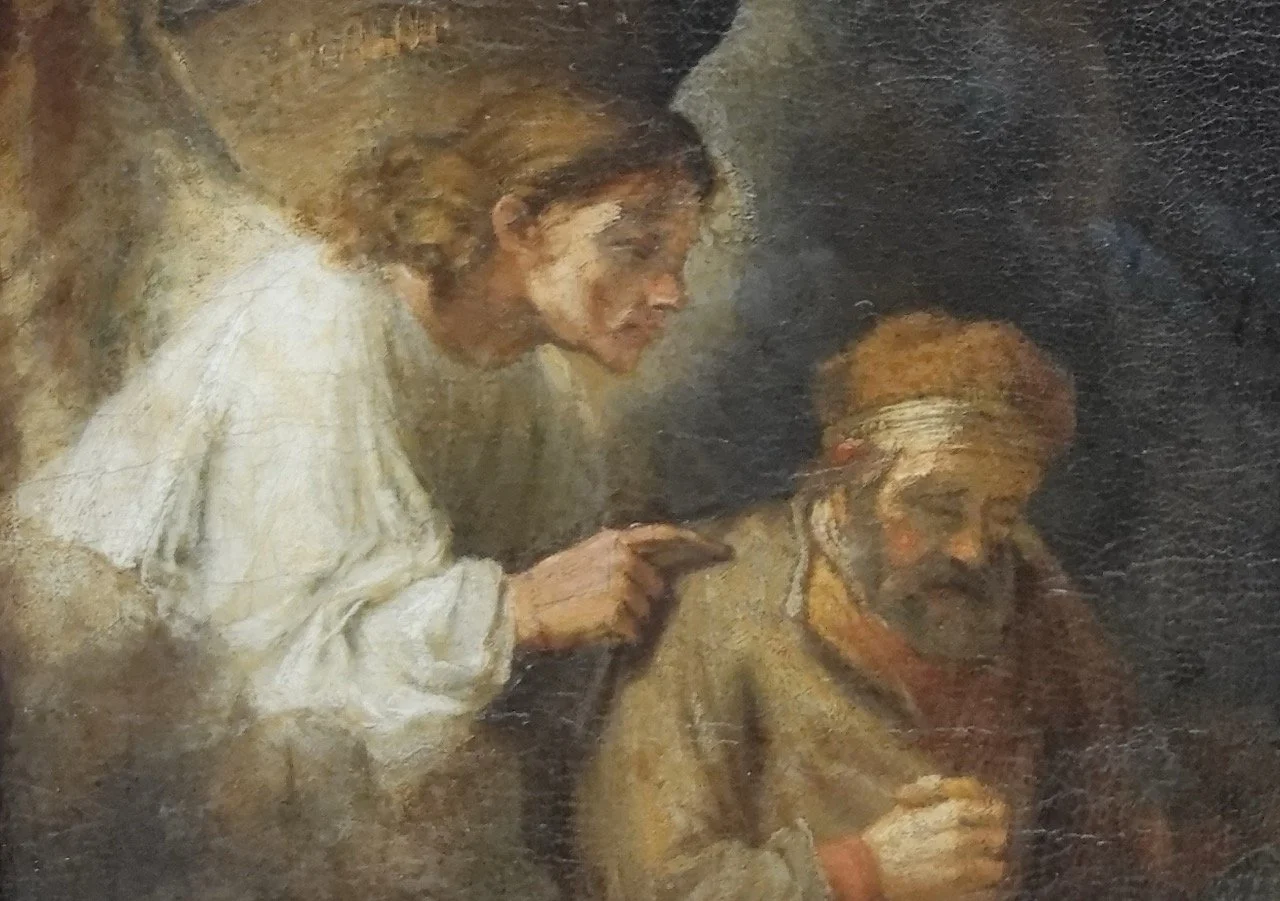
After … Mary was betrothed to Joseph, before they came together, she was found with child of the Holy Spirit. Then Joseph her husband, being a just man, and not wanting to make her a public example, was minded to put her away secretly. But while he thought about these things, behold, an angel of the Lord appeared to him in a dream… (Matt. 1:18-20)
The text passes over these events pretty quickly, and we should be careful not to invent whole stories where the Word itself only gives us a few lines. But those few lines do say a lot. Mary was found with child. Joseph knew he was not the father. Think about the emotions that he would have experienced. His eyes would have told him that he had been betrayed, and that kind of betrayal cuts deep. And it’s not like he was twitching at shadows—it’s not like he saw Mary talking to some guy and jumped to a conclusion. She was pregnant. The Word doesn’t tell us how that whole conversation went, but it does tell us that Joseph was a just man who took that emotional reaction and subjugated it to a consideration of what was right. He thought before he acted. And that is the job of the understanding. We need to use our ability to search for the truth to keep ourselves—and our feelings—in line, and that effort is necessary, if there is to be a safe space in us for the Lord to be born.
Again, we don’t know how the conversation went, but presumably Mary told Joseph the truth—told him what the angel Gabriel told her. But Joseph was still “minded to put her away secretly,” which means he wasn’t fully convinced by her story. He had the opportunity to hear the truth, to hear the angel’s words in Mary’s mouth. But he didn’t completely buy what she told him. And maybe that’s reprehensible, but it’s hard to blame him too much. Can you imagine yourself in that situation—hearing your partner tell you that she was pregnant with the Child of God? In any case, we can see that Joseph wasn’t perfect—and neither are we. No one’s understanding comes up with the whole truth all on its own. What’s admirable about Joseph isn’t that he knew exactly what to do, but that he rose above his emotional response and looked for the right thing to do. And when we do that, we give the Lord an opportunity to send His angels to us; and the angels bring the light of heaven and show us things we could not have seen on our own.
Joseph’s thoughtfulness and his measured response to a perceived injury resonates with other teachings from the Word. For example, here’s what the Lord says to us in Matthew about conflict resolution:
Moreover if your brother sins against you, go and tell him his fault between you and him alone. If he hears you, you have gained your brother. But if he will not hear, take with you one or two more, that “by the mouth of two or three witnesses every word may be established.” And if he refuses to hear them, tell it to the church. But if he refuses even to hear the church, let him be to you like a heathen and a tax collector. (18:15-17)
What this teaching communicates is that the Lord wants us to escalate slowly. Start with a one-on-one conversation, and only get other people involved in your dispute if that one-on-one conversation doesn’t work. Don’t make your dispute public unless you have no other recourse. This is essentially what Joseph did: he didn’t make Mary a public example, but tried to fix his issues with her privately. Measuring and disciplining our responses to difficult circumstances is the job of the understanding; and when the understanding does that job, there is a safe space in us—a space that holds angry emotions and hellish voices at bay. And the affection that Mary represents needs that safe space, that quiet space—it needs the boundaries that the understanding establishes. Within that protected space, that affection can receive the Lord.
The other admirable thing that Joseph did is that he got himself out of the way. We read, “Then Joseph, being aroused from sleep, did as the angel of the Lord commanded him and took to him his wife, and did not know her till she had brought forth her firstborn Son” (Matt. 1:24, 25). Like Mary, he accepted that his life was going to go very differently than he had expected it to. He got married, but for months he couldn’t consummate the marriage. Clearly he perceived that that would not have been appropriate. In that significant respect, his own marriage was not about himself (at least not at the beginning). And there were probably other ways in which he took a back seat within his own marriage. Once he realized that Mary was carrying the Son of God, he surely experienced a kind of reverence, or deference. She was doing holy work, and his job was to support her in her work.
A lot of fathers have said that it was hard for them to watch their wives deal with all of the challenges that go with carrying a child—and especially hard for them to be with their wives while they were in labor—because they wanted to do more, they wanted to take on more of the work, but they couldn’t. This is partly because a lot of men struggle with being in the passenger seat (both figuratively and literally), and partly because a lot of husbands genuinely wish they could take their wives’ burdens from them. Think how much more Joseph would have struggled with feeling sidelined when it wasn’t even his child that his wife was carrying! But that was his role: he had to get himself out of the way. The wonderful things that were happening were not about him.
The point is not that men should take a backseat in their marriages; in marriages there should be no dominion of one over the other of any kind (HH §380). The point is that if the Lord is to make His advent to us, our understanding has to yield. Like Joseph we need to try to do what’s right; we need to think about what’s right, so that we can preserve that ordered space within ourselves in which our innocent affections can safely dwell. And then, at a certain point, we have to give it up. We have to tell the Lord, “I don’t know; I just don’t know. Show me.”
When He makes His advent, He’ll come with light that we have never seen before. He’ll teach us wisdom we have never known. It isn’t about what we know; it’s about what He can show us. As John the Baptist said, “He must increase, but I decrease” (John 3:30).
These are just a few things that we can learn from Joseph, as we prepare ourselves to receive a new spirit from the Lord.
Amen.